It’s Sunday; I’m playing with my music collection, content as a fed-and-burped babe. Allow me to explain.
I realized last night that, in tracking my shifting musical tastes via my Last.fm Pro account, I’m basically remaking “Pardon My Icons,” the creative project I launched on this very website in 1995, back when it was still at a tilde address (it did not become zeldman.com until ’96), and which first brought my work to the attention of other creatives who were also discovering the early web and making it their own.
Me, collage, and music
Although I was not serious about it, I started making collage art when I lived in Washington DC in my 20s.
Back then I was serious about composing and producing. I used an Akai 12-track recorder, a rack of synth modules commanded by my Yamaha DX7 with a custom E! card, and a PC running Personal Composer MIDI, arranging, and composition software. I also had an old Selmer Bundy flute, an African reed instrument whose name I forget (and whose “reed” turned out to be a dried locust carcass, as I would discover, to my horror, when the instrument broke), Fender amps, mics, and a variety of percussion instruments with which I made music in my Washington, DC-based recording studio. But that’s a whole ’nother story.
I did not expect to earn a living as a composer, and in that negative expectation I was more than amply fulfilled.
The paper’s arts section editor in those days was named Richard. I’d gotten his attention without soliciting it after creating “Khz” for City Paper. Khz was my weekly music column. I covered the emerging go-go and hardcore scenes, as they were what was happening in DC, and the whole country would soon be listening. Naturally, the Post made me stop writing about that interesting and relevant stuff, and instead paid me $40 per to crank out anodyne concert reviews of mainstream artists like Kenny Rogers when their tours came through DC. (I was comped to the ticket but paid my own travel and gas out of the 40 bucks.)
I typically had 30 minutes from the time the headliner started to call in my review, which meant I had to write it in my head while watching the beginning of the performance, then run to a pay phone booth (kids, ask your parents) and dictate it aloud to someone on the copy desk, before the concert had even begun to build up a head of steam. This wasn’t fair to the artists. I did the best job I could under the circumstances, taking pride in how quickly I could structure and ship a news story. Richard fired me before I could quit, but that, too, is another story.
Most importantly at that time, I lived with a girlfriend. She was an artist and architect who had left that career to study computer programming. We were social (many friends, drinking was often involved), and serious about our art—which, in my case, was music, even if I earned my living writing concert reviews and crafting passable but hardly brilliant ads.
Through all of those ups and downs, and to the side of those major efforts, I kept at the collage for years, putting in several hours a night making the things. When each was finished—and deciding that any art product was finished was damned tough for my restless young mind—I would carefully frame it behind glass, and mount it on the walls of our apartment.
Was it art? Just a hobby? Who knows? It made me happy.
And then gradually, as I put more effort into my music and ad careers, I set the collage-making aside, for a time.
New career in a new town
Ten years later, I was a New York art director and copywriter, two years sober, and no longer in that same romantic relationship. That’s okay, I was in a new one.
I’d packed my music studio equipment—now obsolete because Akai stopped making the proprietary multitrack tape format that their 12-track unit ran on—in a storage unit. Eventually I’d give away all that music and recording equipment (keeping only the multitrack masters), but that, too, is another story.
The client was Warner Bros., the project was “Batman Forever,” our visionary client was Donald Buckley, my partners were Steve McCarron, Alec Pollak, and Doug Rice, and the website was a huge hit, attracting half the people who visited the early web. (Alec’s “Flashback 1995: batmanforever” shares screenshots, which are great, although they cannot convey what a breakthrough the site was in March, 1995.)
With 3 million people using the web in 1995, the site got 1.5 million visits a day for over a year. Not bad.
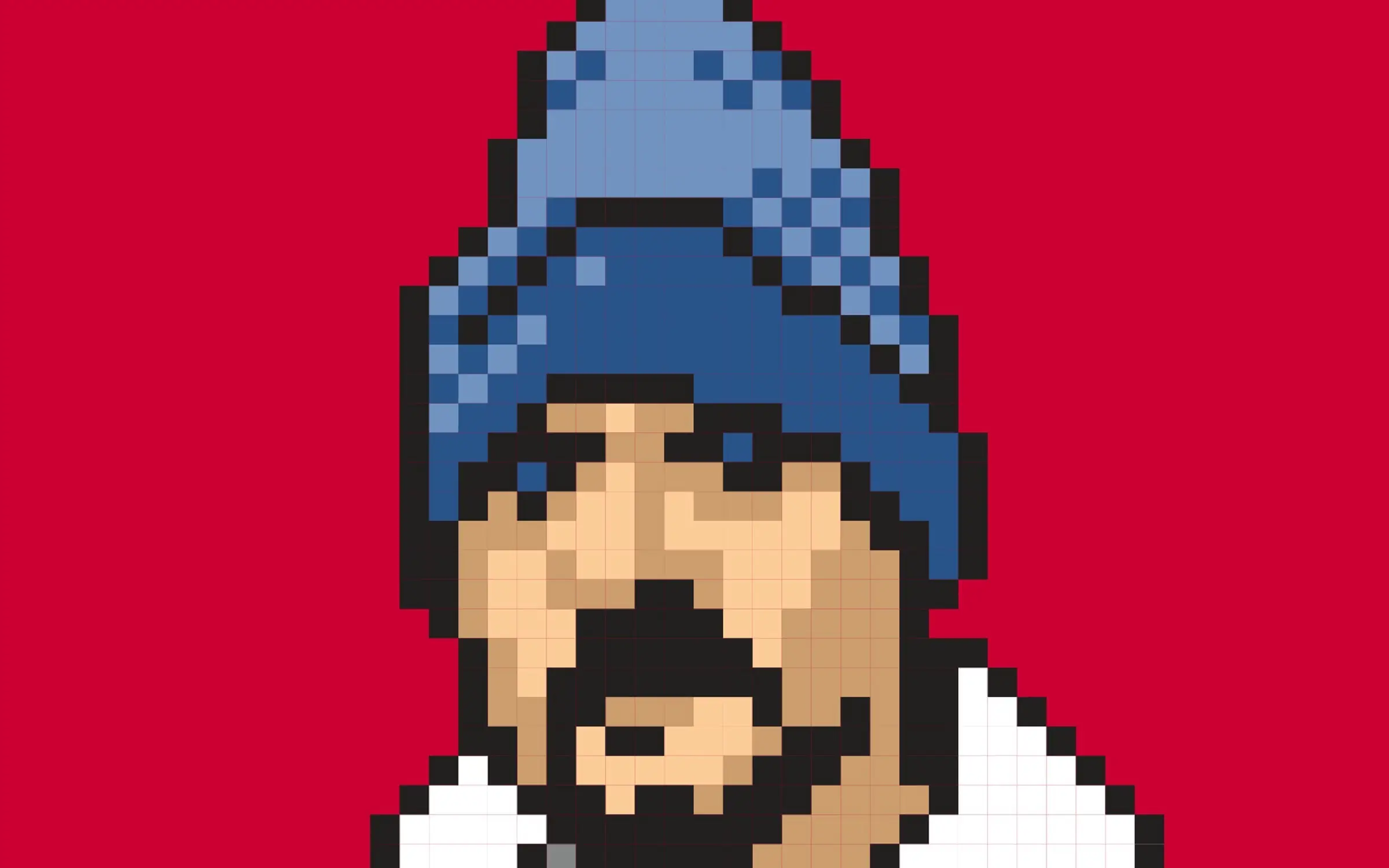
Pardon my icons (1995)
I immediately set to work creating a personal site (this one), and Pardon My Icons was one of its first “entertainments.”
As is often the case with my creative efforts, I made these tiny, Warhol-inflected bits of art as a protest against what I saw as the mediocrity of the icons in general use on that early, early web.
(Similarly, my friends and I would later start The Web Standards Projectin protest against the dumb ways most folks were being told to create websites, e.g. using proprietary tags instead of W3C and ECMA standards, because browsers didn’t properly support those. Having lost access to my musical master tapes because I’d invested in Akai’s non-standard and eventually discontinued tape format, I was kind of keen on not letting the internet fall victim to the same kind of nonstandard f*ckery. But that, too, is another story. We are gathered here to talk about icons and collage. So let’s do that:)
A mental break
I track my music on Last.fm Pro. Here’s my account. (But don’t look unless you, too, have a Pro account. I’ll explain why in a moment.)
Some of the artists I listen to, as shown on last.fm Pro.
Last.fm lists the artists you play, arranging them by the number of plays. Thus, if you were to play three tracks by Freddie Gibbs and two by Bill Evans, you’d have a collage featuring those two artists, with Freddie preceding Bill because he has one more play than Bill.
But if you play three tracks each of Freddie Gibbs and Bill Evans, then Bill will come first, because Bill comes before Freddie alphabetically.
Through such moves, over time, an ever-shifting collage unfolds. But only in Last.fm Pro.
In regular, free old last.fm, you can see other people’s artists as a list, arranged by number of plays, interrupted by an ugly barrage of ads. This is a useful free service for those who are curious about what their friends listen to. But it is a list, not an artful collage, of course.
Collage for days
In Pro, you can see their artists and yours as an ad-free collage that goes on for pages and pages. Plus, as a Pro user, you can choose which photo represents which artist—and even upload your own. When viewing your collection, you and your visitors will see a collage of your favorite artists, in descending order of plays (and with the English alphabet deciding who at each play count precedes whom), using artwork you not only select, but you can also create and upload to the service.
I like Pro. And even though the product isn’t exactly in what you’d call hyper active development—even though the server isn’t always fast, even though there are a few bugs that will probably never get fixed, even though new features are introduced rarely, and the company’s customer service department isn’t exactly the most active help desk in tech—despite those minor drawbacks, the site does things no other website can do. And at US $3, the Pro account isn’t exactly priced out of reach for most customers. (If you can afford a computer, internet access, a music collection and/or a music streaming service, you can probably scratch the 3 bucks together as well.)
How to collage on last.fm
By controlling what I listen to, and the order in which I listen, I’m slowly building an infinite collage of my evolving musical tastes.
By choosing or finding the artist photos (often post-producing them in Photoshop), I create my mood, my rhythm, and my shifting color palettes.
There are design rules governing where portraits should be placed. For instance, people whose face or gaze points rightward get placed on the left of the grid, so they lead the viewer’s eye from left to right, into the composition, whereas those who gaze to my left belong on the right side, leading the viewer’s eye back in.
To reposition someone, I may listen to a few extra plays of them. Or use last.fm’s Pro Admin to subtract a few plays.
When I started using Last.fm, I merely wanted a visual record of what I was listening to, and when I listened. But as you may have inferred, an accurate count of everything I’ve listened to over the past years is no longer my goal in using last.fm; the goal is now the endless collage.
It’s kinda spiritual.
(Reminder: the only way to see it is to be a Pro member of last.fm, which turns off ads and enables you to view your own and other people’s collections in a grid format instead of a list. If you’re a non-member, you see a list jammed with ads.)
If a tree falls, is it art?
Unlike the real-world collages I made in my 20s (which could be mounted on a wall), and unlike 1995’s “Pardon My Icons” (which could be viewed in any browser connected to the web), my current art-making/hobby activity is not publicly viewable except by last.fm Pro users. And that’s okay. ’Cause I’m not designing this for anyone besides myself to enjoy. I mean, if you see it, cool. But if nobody ever sees it, engaging with it will still make me happy.
Which makes this collage business—what? Therapy? Gaming? (Just of a different sort than anybody else?) A form of stimming? It definitely helps lower my general anxiety, providing a space where I can make pretty pictures while listening to my favorite music, which, driven in part by the desire to expand the collage, is widely inclusive and always expanding.
The hunt for fresh collage material also helps keep me interested in new music. (Readers who feel stuck, take note.) And my collage-making, however unimportant it may be, also provides a needed mental health break during these hellish times.
I do this activity every weekend when my more normal friends are biking or baking or dancing.
Is this activity, into which I’ve now poured many hours of my life, artistry or autism? Who cares? The point is that it’s escapist and harmless and we all need some of that in our lives, however we can grab it.
However you grab your moments of calm, meditation, and happiness, never be ashamed of taking care of yourself.
See also…
Rediscovering music: If Spotify exposes you to new music other people are listening to, Last.fm helps remind you of great music in your existing collection that may have slipped your mind.
For love of pixels: Stroll with us down memory lane as we celebrate the pearl anniversary of pixel art creation’s primary progenitor, and some of the many artists and design languages it inspired.
I started using Twitter before the dawn of the iPhone. Back then, in 2006, it was a fun, funky, fully functional (if barebones) beta messaging service used mainly by The People of the Web™—the kind of folks who attended the SXSW Interactive conference and probably spoke on the panels.
You know. You were there. You were one of us: Designers. Developers. Pioneers. Writers of blog posts, trade books, and all the little guide texts that websites depended on to attract and serve their users. People who, in casual conversation, might use words like “digerati” unironically and without intending to be pretentious.
We believed in the power of the web to highlight unheard voices and evolve a more just society. If we were naive, and we surely were, at least we were on the side of the angels. Turns out, not everybody was.
A new skill
Years before Slack, the early 140-character Twitter served as a kind of private pre-Slack for the digitally awake and aware.
Back in those days, if you’d asked me or my conference-going fellow bloggers and designers who that first, rudimentary Twitter was for, we’d have said it was for us. For people like us, who’d spent years mastering all manner of skills and technologies simply to communicate online. Who saw value in the act of putting words together, so long as there were people to read and react to those words.
(After expressing our feelings of pride and ownership in the Twitter community, of course, the more Ted-talk-y among us early users would have waxed rhapsodic about microblogging and its potential to improve the world. More about that in a moment.)
With the birth of Twitter, when we wanted to pin down something that was twitching about in our heads and transmit it to other heads, the skill we needed wasn’t CSS or HTML or art direction or back-end wrangling. It was the ability to edit our thoughts down to a glittering trophy built with 140 characters or less. A new skill to master!
How much do people like us love showing the world what we’ve learned! This much: Even after Twitter no longer relied on wireless carriers’ text messaging services, so that the permitted character count was consequently doubled, many of us would-be Oscar Wildes continued to whittle away at our tweets, limiting them to 140 characters or fewer on principle.
Years later, with a huge international user base, the idea persisted that a globally connected free and open messaging network like Twitter could help humanity do less evil and more good.
If you wanted proof, you could look to the first Arab Spring, to Me Too, to Occupy Wall Street and Black Lives Matter—movements that were greatly abetted by the busy, worldwide network.
Of course, while many cheered and participated in these activist-driven movements, others saw them as threatening. Some felt the world was changing too fast, and that their views on social issues, like their once-good jobs, had no champion among the ruling classes. We all know how that turned out.
And now a brief digression about power and megaphones:
How I got over
Nearly two decades before Bluesky and its sweet starter packs, Twitter hired creatives to recommend selected users to newcomers. Some of the coolest people I know did that work.
Web design was at its peak, so quite naturally the in-house team put together a list of influential designers, developers, and writers for new users to follow. And for a variety of reasons, I was among those early recommended follows. (I may still be listed there, if the current X still welcomes newcomers with follow recommendations.) Which is how, at my Twitter peak, I ended up with a blue checkmark and 355,000 followers.
Even now, on wretched “X,” where I no longer post, I still retain 305,000 followers. At least, that’s what the stats told me when I popped in just now to find out. But are there really that many folks following me there?
How many of my current Twitter/X “followers” used to participate but have since quit quietly, without bothering to close their accounts? Lots, I reckon.
Some may avoid the site but keep their accounts open for strategic reasons, such as preventing someone else from hijacking their name (not that the owner can’t take over your account whenever he feels like it—but I digress).
Mainly, I’m guessing a lot of folks lost interest in the site but forgot to close their accounts. In other words, the data says 305K, but it’s probably less than half that many active users at most, few of whom would even see my tweets if I still posted there, as the algorithm throttles texts from folks like me.
Who cares, besides me? Nobody. Nor should they. And, besides, except as a temptation to stay, my follower count is beside the point.
Come play with us, Danny
The point is that the former Twitter has become a hateful cesspool, not simply mirroring but amplifying its owner’s profound insecurities, god-awful beliefs, and self-serving lies, and forcing that insanity into the public consciousness, whether we avoid X or not.
Thus, millions of Americans who don’t use Twitter/X nevertheless believe conspiracies that the owner and his favorite acolytes use the site to broadcast.
If you have a website that gets steady but diminishing traffic, and whose domain registration dates back at least a decade, you may encounter offers to buy your domain. These used to come mainly from pornographers, on the premise that your readers, upon encountering nudity instead of the morning farm report in their web browsers, would be momentarily confused—but at least a few of them would stick around to become customers.
Over the years, tricking people into seeing unexpected content and converting a small percentage of them into customers has proven to be an effective business tactic. Mindless, sure. Depressing, you bet. But effective. If all you want to do is make money, this is a way to do it. See also the penny rounding error crime from Office Space (by way of Superman III). It’s a numbers game. Make an infinitesimal profit a gazillion times, and it becomes a healthy profit. Buy skrillions of popular domains at a low enough cost, and rake in double your money in subscription fees and paid downloads.
These days, of course, the lowball domain harvesters are not limited to pornographers or even human beings, but the point of the transaction has ever been the same: to ambush your community and convert at least some of them into customers.
What I’m working up to is that, for some reason, this morning I woke up recognizing that Elon Musk’s purchase of Twitter was a far more expensive—and destructive—version of that same old grift. It was conversion en masse. To seize a public commons shared by 600 million readers, writers, and keyboard adrenalin addicts, and to profoundly change the conversations they were having. A digital takeover with historic and deeply tragic real-world consequences.
For sale: personal, imperial power
Musk’s “folly,” it turns out, wasn’t the ego-fueled, soon regretted impulse purchase it looked like. At least, if it was that, it was not only that. It was also, as we can see now, a plan to buy not merely a U.S. presidential election outcome, but, with it, personal, imperial power. Whether that was always the plan, or only became the plan after Musk found himself stuck with the $44B Twitter deal and decided to make the best of it, the consequences for our world are the same. And, from Musk’s point of view—at least until he and the man he helped put in the White House have their inevitable supervillain falling out—the plan worked.
A psychological detail here is that, in contrast to the lowballing sleaze merchants whose tactics he otherwise emulated, Musk appeared to have wildly overpaid for his prize. How could he be so stupid, we grinned at each other—and put him out of our minds. Which gave him that much more freedom to make his moves. Which, although evil, were not stupid.
As an unelected U.S. co-president in an administration in which two-fisted self-dealing will be expected, and will go unreported by a weak and cowering press, Musk will become his own Treasury Department in his role as a cutter of “government waste.” (End Medicare. Get a job, Grandma! Launch Medicare dollars into SpaceX. While we’re at it, let’s stop pampering our military veterans with health care. And so on, ad nauseum.) And if that’s not enough—and somehow it never is enough for these people—he’ll also rule over economic realms in which his companies compete for astronomical government contracts. Gee, I wonder how that will go?
Either Musk deliberately spent enough to make his enemies think he was an idiot, and stop paying attention to him. Which is evil-genius-level chess-mastery if it was, in fact, planned that way. Or else he overspent as a bluff, got tripped up in his own hubris, ended up stuck with Twitter, decided to wreck it while high on Ketamine, and somehow blundered his way into a revenge plan for the history books—if we’ll still be allowed to have those. Either way, the rest of us are in the same bad trouble.
All things considered, the Titanic sank quickly. Our democracy has just a tad more time. What can good people do today to give non-billionaires a fighting chance?
Just as nobody who marries spends their wedding day planning their divorce, almost nobody starts a business contemplating what rocks it will eventually splinter and break upon, and how to build a life raft for themselves.
I take that back. Some folks I know, who played pivotal roles in the evolution of the web, actually started their businesses with a clear goal of selling them to somebody bigger. Like Typekit was designed to sell to Adobe. Or Blogger was designed to sell to Google.
Such folks, several of whom are now post-economy wealthy, lived in the Bay Area in the 1990s and early 2000s, where building to flip was widely discussed and accepted.
Meanwhile, in NYC…
I, on the other hand, live in New York. So I started my web businesses (like Happy Cog™ design studio) to serve clients, as NYC creatives have always done, and with no understanding that I would one day need to leave the company and should have an exit plan. Why would I exit? Why would I ever stop doing work that brought excitement and meaning to my life?
Similarly, I started my personal site with its “Ask Dr. Web” tutorials in 1995, and co-founded my web design publication, A List Apart, in 1997, for the sheer joy of sharing knowledge, with no concept of making money, let alone of one day selling the business.
Eventually, despite my naivete, and mostly thanks to Jim Coudal and Jason Fried, A List Apart began making money by running one carefully screened ad per page. I used that money, as you will expect, to pay our writers, editors, and producers. And when it came time to stop running ads, I slowed our publication schedule, paid writers out of my own pocket, and worked with a small crew of fellow volunteers, who published ALA because we believed in the mission. (Still do.)
If I had come of business age in San Francisco, I likely would have sold A List Apart to somebody like O’Reilly, but that was never my plan because I make toys to play with, not to give away.
We published HTML5 For Web Designers the day after Steve Jobs, waving an iPhone on the world’s biggest stage (okay, sitting at his desk), announced that Flash was dead because HTML5 would bring app-like dynamism to the web using open standards instead of proprietary code. It (our first book, I mean) sold brilliantly. “Gee, publishing isn’t that hard” I naively told myself. (No, I knew it was hard. My favorite publishers had been laying off my favorite editors for ten years before my partners and I took the plunge. But the early success did make me think the books we published about web design would always find a large, eager audience. In time, I would learn otherwise.)
And while we began the publishing house by relying on the best writers we knew personally to write about the topics they were most passionate about, I’m proud to say that, as we went along, we also discovered brilliant first-time book authors, helping them create perfectly polished, fluff-free manuscripts that made genuine contributions to our readers’ understanding of UX and all it entails. (And not just to our readers. The insights they brought to their work after digesting our books rubbed off on their colleagues.)
In giving these brilliant writers a platform, we not only helped them take their careers to the next level, we also helped people who create web content think and work better, which in turn helped the people who used the websites, applications, and products our readers designed and built. Of that, I am proud.
Stay hungry
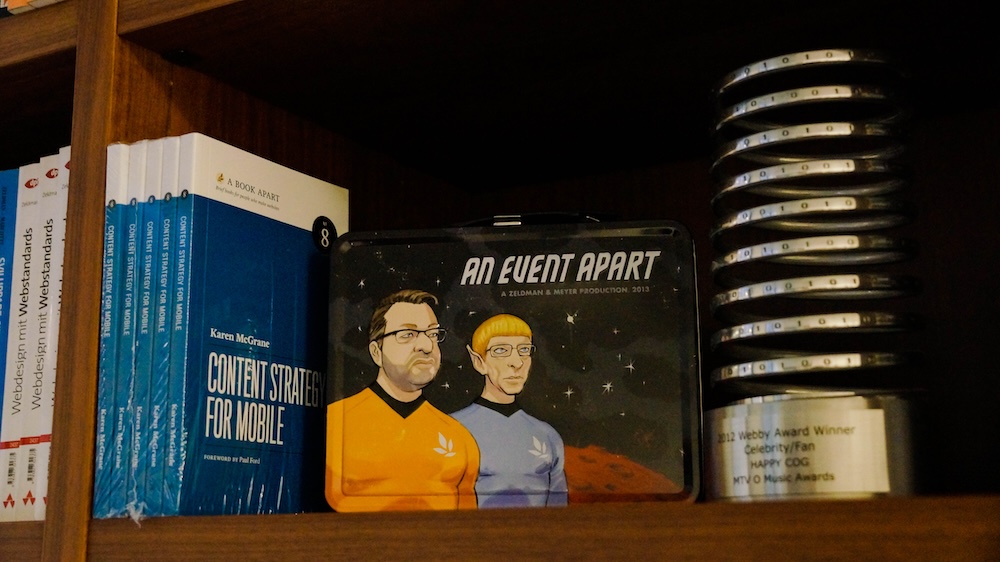
An Event Apart (RIP) was also a damned fine early success. Web designers liked our innovation of a multi-day, single-track conference, with a holistic approach to web design, code, and content, and unifying themes between the individual talks. Our freaking-amazing speakers debuted Huge Ideas including Mobile First and Responsive Web Design—ideas which, like perfect contextual menus in UX, arrived at the very moment designers needed them.
Not only that, but these humble geniuses also sat in the auditorium with our audience for all three days of each conference event: listening to each other’s presentations, and updating their own presentations to better bounce off each other’s ideas and the evolving themes of that particular show.
I could spend hours telling you how our producer Toby M. made miracles happen at every show, or how person-in-charge Marci E. brought joy to our community. How many of our speakers became authors. How some “graduated” from An Event Apart as newcomers replaced them. How the diversity of our speaking line-up, which wasn’t terrific in 2008, improved greatly each year. (Not that we ever said, “We need another black speaker” or “We need a trans speaker” or what-have-you. Just that we learned to swim outside the pool we came from, and discover great talent everywhere.) Our speakers were also almost uniformly Just Nice Good People, which doesn’t always happen when you’re collecting the greatest minds in an industry.
That’s not even to mention the incredible people who attended our shows, some of whom became lifetime friends for me.
So why, given the joy these businesses brought to everyone connected to them, including me, would my partners and I have even conceived of an exit strategy? We wanted the Good Times to roll on forever.
But of course they never do.
Things end
COVID did in An Event Apart. Some conferences survived, of course. Different priorities, different overheads, different business models. Some that survived do not pay their speakers. Others, where the conference is an adjunct to a bigger business, laid off or reassigned conference staff while the pandemic made live events impossible. Others that survived mostly rely on volunteer labor, whereas we had paid staff. They were worth their weight in platinum, and we’d have paid them more (because they were worth more) if the pandemic and six-figure hotel contracts hadn’t made continuing the show impossible. My partner and I earned nothing during the business’s last five years, and got personally stuck with a six-figure debt when the event closed. It is what it is.
Although books should be COVID-proof, multiple financial problems eventually beset our publishing house as well. For most of the run of the business, my partner and I earned nothing beyond the glow of contributing to our community’s knowledge. We paid our CEO, authors, and editors, kept nothing for ourselves, and tried, oh how we tried, to keep the business going as its revenues tanked.
Speaking only for myself, I’ve learned that I am good at starting businesses and keeping them going creatively, as long as somebody else figures out the money. I suck at that, and I’m obsessed with the notions of fairness and self-sacrifice that were drummed into me by a narcissistic family that valued me for taking on the roles they were emotionally incapable of handling—such as bringing up my baby brother in my father’s absence, which no child is equipped or should be asked to do, and yet it happens all the time. Growing up this way made me put my own self-interest last. Which is also why it never occurred to me to plan an exit. And by the time I needed to do so, the businesses were not in shape to sell.
Closing a conference is bad, but attendees can go to other conferences, and speakers can speak at other conferences; closing a conference doesn’t end a community. It sucks for the business but doesn’t strand participants.
But closing a publishing house hurts like hell, and you feel you let everybody down. I know how much our closing hurt some of our authors, and I think about that, instead of the good we achieved, when I look back.
No doubt when my partner and I write the large personal checks to cover our deceased business’s outstanding debts, we’ll be regretting the harm our closing caused, not basking in the warm glow of how many careers we changed for the better. Like the standup comedian who obsesses about the guy who’s frowning at table 3, and doesn’t hear the laughter of the rest of the crowd. We also, hopefully, won’t focus too closely on our financial wreckage. Just pay the bill, and move on.
Anyway, I hadn’t publicly addressed the endings of these businesses, so I figured it was time to do so. I’m sharing my experience only. If you ask any of the people I worked with on these projects, they might have a different story to tell. And that would be their story, and it would be every bit as valid as anything I’ve said here.
I also didn’t ask permission of my partners, speakers, or authors before sharing these thoughts. Probably I should have. But, hey. As I’ve said. I’m speaking here only for myself.
So, anyway.
Parting gift
Is it worth the risk of starting a web-related business that isn’t a venture-backed startup? I still think it is, and I applaud all who try. Heck, I might even do so myself someday. If you’re doubtful because of (((gestures at everything))), it might be worth noting that I started Happy Cog™ during the dot-com crash, when studios were closing all around me. And we launched A Book Apart during the world financial crisis of late 2008. Don’t let (((all this))) deter you from trying something bold. Let me know when you do. I’ll keep watching the skies.
P.S. Under swell third-party ownership and management, Happy Cog is still going strong. Check it out!
I’ve started a Bluesky list featuring some of the brilliant writers, designers, coders, editors, and others who’ve contributed to A List Apart “for people who make websites” from the magazine’s first dawning back in the 19(mumbles). Bluesky fans, grab the list here:
Why only *some* of the contributors? Simple. Several are, sadly, deceased. Many others are likely alive and well but not yet on Bluesky. We can’t unmake death, but we can offer the living networked comradeship and a wee increase in visibility.
So if you’re an A List Apart contributor who’s been thinking of joining Bluesky, consider this an incentive. Note: I’m not a partner in Bluesky, and have nothing to gain from inviting you, beyond the pleasure of your company—be it salty or sweet.
Once you join and have started a profile, ping me and I’ll add you to the list. (I’m zeldman.bsky.social on Bluesky.)
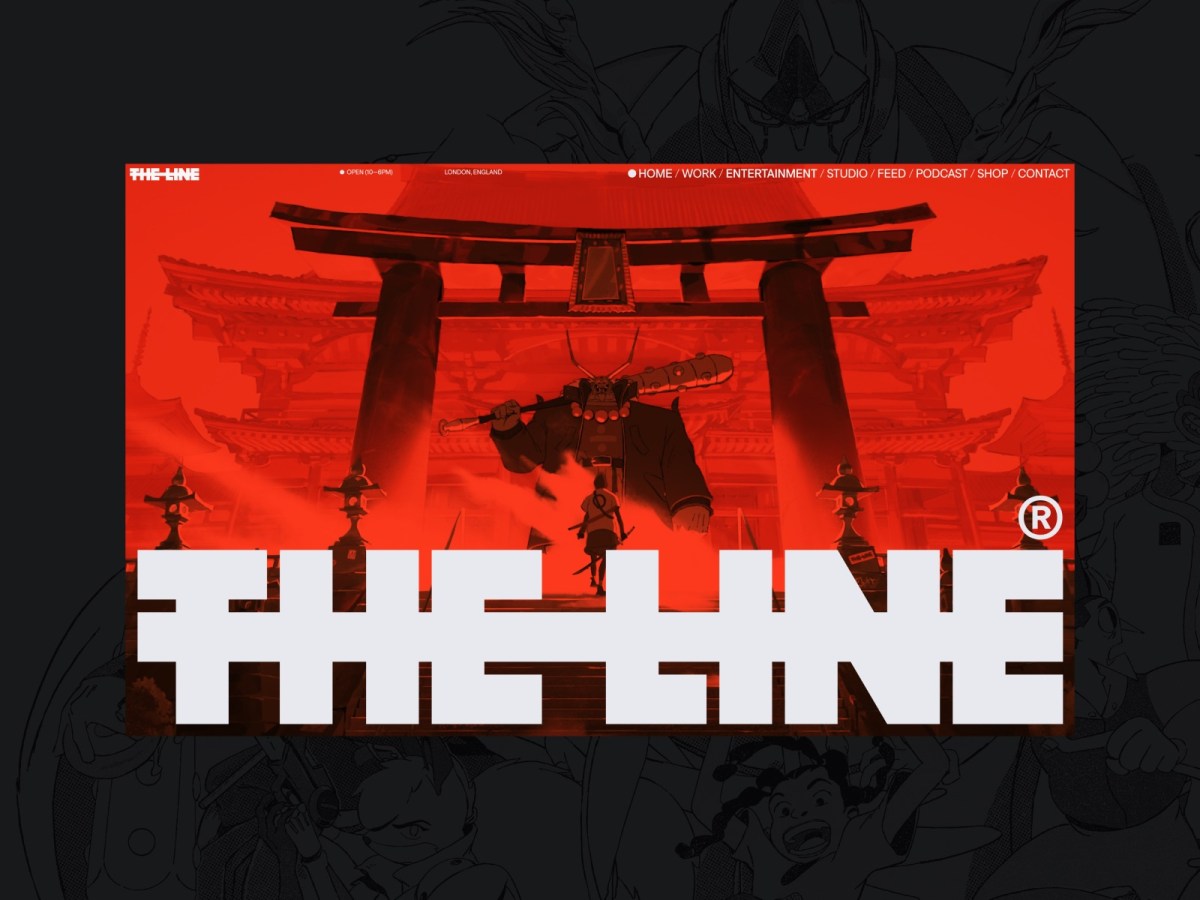
Red, black, and white. Always a good look. Screenshot of The Line website.
If you’re finding today a bit stressful for some reason, grab a respite by sinking into any of these web design inspiration websites.
Gathered from conversations on Reddit and elsewhere, each site offers a collection of other sites’ designs, chosen for impact, originality, and innovation. Each collection should offer at least a few designs that will inspire your own ideas and creativity—and most contain more than a few. Lots more.
We make no claims as to usability, accessibility, or appropriateness of design. Which doesn’t mean that the chosen websites are unusable, inaccessible, or inappropriate to the brand, subject matter, or needs of the audience. Indeed, from the care devoted to the graphical interface, we assume that many of these sites are as good under the hood as they are on the surface. But it’s just an assumption; we haven’t tested, and the point of this post is purely to share visual and creative inspiration. Enjoy!
ONE MONTH and 24 years ago, in “Where Have All the Designers Gone?” (my HTMHell design column for Adobe of March 20, 2000), I discussed the deepening rift between aesthetically focused web designers and those primarily concerned with creating good experiences online:
More and more web designers seem less and less interested in web design.
Over the past 18 months or so, many of the best practitioners in the industry seem to have given up on the notion that a low-bandwidth, less than cutting-edge site is worth making. Much of the stuff they’ve been making instead has been beautiful and inspiring. But if top designers wash their hands of the rest of the Web, whose hands will build it, and whose minds will guide it? The possibilities are frightening.
An Imperfect Medium for Perfectionists
Why were many of the leading graphic designers and studios at the time uninterested in web design? For one thing, designers trained to strive for visual perfection found the web’s unpredictability depressing. The article provided clues to the frustrations of the time:
Good designers spend hours tweaking typography in Illustrator and Photoshop. Then visitors with slow connections turn off images.
Of course, where professionals trained in graphic design saw a distressing lack of control, others glimpsed in the infant technology a tremendous potential to help people, pixel-perfection be damned. To reduce the conflict to a cartoon, you might characterize it as David Carson versus Jakob Nielsen—though doing so would trivialize the concerns of both men. Designers already charged with creating websites found themselves somewhere in the middle—barking themselves hoarse reminding clients and managers that pixel-perfect rendering was not a thing on the web, while arguing with developers who told designers the exact same thing.
Visually inspiring websites like K10k showed that the web could, if approached carefully and joyfully, provide aesthetic delight. But many designers (along with organizations like AIGA) were unaware of those sites at the time.
Us and Them
Another source of tension in the medium in 2000 sprang from the discrepancy between the privileged access designers enjoyed—fast connections, up-to-date browsers and operating systems, high-res monitors (at least for the time) offering thousands of colors—versus the slow modems, aging and underpowered computers, outdated browsers, and limited-color monitors through which most people at the time experienced the web.
Which was the real design? The widescreen, multicolor, grid-based experience? Or the 216-color job with pixelated Windows type, a shallow “fold,” and pictures of headline text that took forever to be seen?
To view your masterpiece the way most users experienced it, and at the syrup-slow speed with which they experienced it, was to have an awakening or a nightmare—depending on your empathy quotient. Some designers began to take usability, accessibility, and performance seriously as part of their jobs; others fled for the predictability of more settled media (such as print).
A New (Old) Hope
My March, 2000 article ended on an upbeat note—and a gentle call to action:
For content sites to attain the credibility and usefulness of print magazines; for entertainment sites to truly entertain; for commerce sites and Web-based applications to function aesthetically as well as technically, the gifts of talented people are needed. We hope to see you among them.
That was my hope in 2000, and, all these years later, it remains my vision for this web of ours. For though the browsers, connections, and hardware have changed substantially over the past 24 years, and though the medium and its practitioners have, to a significant extent, grown the Hell up, beneath the surface, in 2024, many of these same attitudes and conflicts persist. We can do better.
Minus the framesets that formerly contained it, you may read the original text (complete with archaic instructions about 4.0 browsers and JavaScript that broke my heart, but which Adobe’s editors and producers insisted on posting) courtesy of the Wayback Machine.
The wizards behind AI have been busy lately providing meaningful employment for digital nonpersons.
One of the hottest jobs for non-humans is crafting and deploying website guestbook spam. This market’s on fire!
If you thought the guestbook spam of yore was impressive, you ain’t seen nothing yet. The new, AI-assisted comment spam has improved keyword stuffing, fewer grammatical mistakes, and, best of all, there’s tons more of it. Your Comment section was never so useless!
And we’re not just talking quantity, here; we’re talking quality.
Compared to the spammers of yore, the new signal depressors have a bold confidence that proclaims, “Hello, world! I’m here to waste your time and extinguish what’s left of your hard-won reader community. Watch me work!”
Yes, the bots who shit in your sandbox are bigger, brassier, and better than ever at wasting your readers’ time and abusing your content to score points on the Google big board.
What’s that you say? You’re not a comment spam enthusiast?
In that case, do as I do: use Akismet to keep cruft where it belongs: off your website. Akismet was strong enough for the comment, form, and text spam of the past, and it’s strong enough for the new junk, too.
(Full disclosure: I work at Automattic, makers of Akismet, but I penned this post this morning purely as an Akismet customer, after happily reviewing the blocked comment spam on this here WordPress site of mine. Thanks, Akismet!)
Ever since an infantile fascist billionaire (hereafter, the IFB) decided to turn Twitter over to the racially hostile anti-science set, folks who previously used that network daily to discuss and amplify topics they cared about have either given up on the very premise of a shared digital commons, continued to post to Twitter while holding their noses, or sought a new digital place to call their own. This post is for the seekers, to compare notes.
These are my personal observations; your views may differ (and that’s more than okay). In this quick survey, I’m omitting specialty platforms like Tribel, Post, and Substack. Feel free to comment, if you like.
The platforms
BlueSky: The most beautifully elegant web interface. Also the best features (other than omission of hashtags). What Twitter should have become. I joined late—Jack didn’t invite me, likely a sign that I was no longer industrially relevant. I have few followers there, and my posts so far get little traction, but that could change. It’s so pretty (and the few friends that use it matter so much to me) that I keep using it, and I reserve judgement as to its future potential. https://bsky.app/profile/zeldman.bsky.social
Threads: Currently my primary alternative to Twitter, and the only place besides Twitter where my posts get at least some response. Not as visually refined as BlueSky, and with a curiously restricted single-hashtag-only policy. Although this editorial decision helps focus the mind, and likely also cuts down on spam, it interferes with amplifying multidimensional posts. But I digress.
Rough edges and restrictive tagging aside, Threads feels like the place that’s likeliest to inherit the mantle of default town square—if any social platform can do that in these new times, that is.
Threads got its huge jump start because, while the IFB was busy finding new ways to make Twitter less useful and more dangerous, Meta leveraged its huge installed Instagram base to give users a more or less instant social network hookup. If it’s easy, and comes with a built-in network of people I already follow, it wins—at least initially.
Meta may also blow their opportunity if they pursue misguided policies, such as impeding (by algorithmic fiat) “political speech” when democracies hang in the balance, regional wars threaten to become world wars, and the climate crisis is approaching a point of no return. https://www.threads.net/@zeldman
Mastodon: How do you decentralize a digital town square? Provide universal social connection without locking in participants? Mastodon (and federation generally) are an attempt to do those things.
These are important and noble goals, but Mastodon (and federation generally) are a long shot at replacing a primary walled garden like Twitter because they require a fair degree of geekery to set up, and the price tag of mass acceptance is ease of setup. (Compare Threads—easy set-up, built-in friends and followers if you already use Instagram—versus the learning curve with Mastodon.)
If BlueSky is MacOS and Threads is Windows, Mastodon is Linux: a great choice for techies, but likely too steep a hill for Ma and Pa Normie. A techie friend invited me to join, and I write there frequently, but, for whatever it’s worth, my Mastodon posts get very little in the way of responses. It is, nonetheless, a highly effective network for most who use it. https://front-end.social/@zeldman
Tumblr: A bit o’ the OG weird wacky wonderful web, and a special place for nonconformist creative types. By its nature, and the nature of its fiercely loyal users, it is a cult jam. I was an early and enthusiastic Tumblr fan, but it was never my main axe, probably because, since the dawn of time itself, I have had zeldman.com.
For a while, when the IFB first started wrecking Twitter, an uptick in Tumblr usage suggested that the funky old network just might take over as the world’s town hall, but this hope was unrealistic, as Tumblr was never about being for everybody, and Tumblristas are mostly happy keeping the platform a home for self-selecting freaks, queers, and creatives.
I’ll note that Tumblr is part of the Automattic family, and I work at Automattic (just celebrated my fifth anniversary there!), but my opinions here are mine alone. BTW—in nearly 30 years of blogging, that’s the first time I’ve used that phrase. https://apartness.tumblr.com
LinkedIn: A comparatively safe social network with a huge network built up over years, hence a great place to share work-related news and ideas.
Some early Twitter adopters of my acquaintance—especially those who mainly write about work topics like UX—have made LinkedIn their primary social home. For most working folks, it is undoubtedly a place to post and amplify at least some of the content that matters to you. OTOH, it’s not a place where I’d share deep takes on CSS (that’s probably Mastodon), cosplay (Tumblr), or personal true confessions (one’s blog, Threads, Twitter before the IFB took over). https://www.linkedin.com/in/zeldman
Twitter itself: During its heyday, before the IFB, and when it was the only game in town, I loved going there to see what clever things my smartest friends were saying, post my own bon mots, and promote content that mattered to me.
I’ll limit my comments on Twitter’s current state to noting that I still post there, from stubbornness as well as habit, and primarily in the (increasingly forlorn) hope that the IFB will eventually tire of his toy, or of the ceaseless financial hemorrhage, and go away, leaving the site to rebirth itself as an open source project or under the care of new, non-fascist owners.
Though the algorithm punishes my posts, and though I’m continually appalled by the MAGA posts, Russian disinformation, racist/ misogynist/ anti-semitic spew, and Trumpian ego of the current owner, I shall, at least for now, continue to defend my tiny turf there.
I follow you on Mastodon and even when usually don’t respond to bunch of posts, I can still appreciate people being there. Since I use RSS, I get to read your posts that way usually coming to your website.
[…] In search of a digital town square – L. Jeffrey Zeldman, non l’ultimo dei fessi sul web, cerca di fare il punto sullo stato dell’arte del self publishing oggi; […]
[…] In search of a digital town square – L. Jeffrey Zeldman, talks about the state of the art on mantaining a presence on the web today, with the available tools. […]
Bluesky introduces open-source, collaborative moderation for federated social media websites: Bluesky was created to put users and communities in control of their social spaces online.…
I’ve started a Bluesky list featuring some of the brilliant writers, designers, coders, editors, and others who’ve contributed to A List Apart “for people who…
Who will design the next generation of readable, writerly web layouts?
Layouts for sites that are mostly writing. Designed by people who love writing. Where text can be engaging even if it isn’t offset by art or photography. Where text is the point.
With well considered flexible typesetting, modular scaling, and readablemeasures across a full range of proportions and devices. With optional small details that make reading screens of text a pleasure instead of a chore. With type sizes that are easy to read without needing to zoom in. And with a range of interesting sans and serif fonts (including variable fonts) that support reading and encourage creative exploration where headlines are concerned.
So what comes next? For writers, one hopes that what’s next is a fresh crop of small, innovative advancements. Improvements that are felt by readers, even when they aren’t always consciously noticed. Layouts that are not merely legible, but actually feel inevitable, at all sizes and in all contexts.
Beyond outside the box
Services like Typetura may point the way. A marriage of type and tech, Typetura is different from other typesetting methods. An intrinsic typography technology, it “enables you to design with more flexibility, while dramatically reducing code.” Disclaimer: I’m friends with, and have long admired the work of, Typetura founder Scott Kellum. Designing With Web Standards readers will recognize his name from the Kellum Image Replacement days of the early 2000s, but that ain’t the half of what he has done for web design, e.g. inventing dynamic typographic systems, high impact ad formats, new parallax techniques, and fluid typesetting technology. Scott was also the coder, along with Filipe Fortes, of Roger Black’s late, lamented Treesaver technology. But I digress.
The tech is not the point—except in so far as it improves our ability to think beyond our current understanding of what design and layout means. Just as Gutenberg’s printing press was not the point, but it was the point of departure. Initially, the invention of movable type reproduced the writing we already knew (i.e. the King James Bible). But ultimately, by freeing writing and reading from narrow elite circles and bringing it to more (and more diverse) minds, Gutenberg’s invention transformed what writing was and could be—from the invention of newspapers to the fiction of Virginia Woolf to multimedia experiences, and perhaps even to the web.
Let us all to play with Jen Simmons’s intrinsic web layout ideas and Scott Kellum and partners’s Typetura. While we also sketchin pencil and spend time looking at well designed books —printed, bound ones as well as digital publications in various devices. And specifically, not just fabulous coffee table books, but books that you’ve reread over and over, to understand what, beyond the text itself, encourages that reading response. So that, together, we may take the experiences of both reading and writing to the next level.
Appendix: Resources
If you’re new to the interplay between design and code on the open web, or if you just want a refresher, here are some evergreen links for your further learning and pleasure:
You may not know his name, but he played a huge part in creating the web you take for granted today.
As the first person to realize, way back in 1994, that the emerging web could be a playground, he created Cool Site of the Day as a single-focused blog dedicated to surfacing interesting sites, thereby demonstrating the web’s potential while creating its first viral content. (As an example, traffic from his followers, or, as we called them back then, readers, brought NASA’s web server to its knees.)
He co-founded The Web Standards Project, which succeeded in bringing standards to our browsers at a time when browser makers saw the web as a software market to be dominated, and not a precious commons to be nurtured.
He anticipated responsive web design by more than 20 years with his formulation of Liquid, Ice, and Jello as the three possible ways a designer could negotiate the need for meaningful layout vis-a-vis the unknowns of the user’s browsing environment.
He taught the web DHTML through his educational Project Cool Site.
And then, like a handful of other vital contributors to the early web (e.g. Todd Fahrner and Dean Allen), he vanished from the scene he’d played so large a role in creating.
He’s ba-ack
Glenn Davis wasn’t always missed. Like many other creators of culture, he is autistic and can be abrasive and socially unclueful without realizing it. Before he was diagnosed, some people said Glenn was an a**hole—and some no doubt still will say that. I think of him as too big for any room that would have him. And I’m talking about him here because he is talking about himself (and the history of the early web) on his new website, Verevolf.
If you go there, start with the introduction, and, if it speaks to you, read his stories and consider sharing your own. That’s how we did it in the early days, and it’s still a fine way to do it—maybe even the best way.
I knew Glenn, I worked with him and a lot of other talented people on The Web Standards Project (you’re welcome!), and it’s my opinion that—if you’re interested in how the web got to be the web, or if you were around at the time and are curious about a fellow survivor—you might enjoy yourself.
Our static tools and linear workflows aren’t the right fit for the flexible, diverse reality of today’s Web. Making prototyping a central element of your workflows will radically change how you approach problem solution and save you a lot of headaches – and money. But most importantly, you will be creating the right products and features in a way that resonates with the true nature of the Web. A discourse on processes, flexibility, the Web as a material, and how we build things.
A liquid page will resize to fit whatever size browser window (within reason) that the user has available. … the real goal in building a website is to provide the user with a seamless interface to information. The site should not intrude on the user’s thought processes, but should gently guide them to their desired destination. If a site doesn’t look right because it doesn’t fit the user’s browser window, then the design has become intrusive to the user.?—?Glenn Davis, quoted in 15 Minutes, sometime in 1997.
TWO DECADES before Responsive Web Design, we dipped our toes in Liquid Layout?—?a similar but necessarily less refined concept. Glenn Davis of Project Cool fame coined the phrase in 1995 or 1996. (Glenn also came up with“Ice” to describe fixed-width layouts, and “Jello” for layouts that combined some fixed with some flexible elements.)
Liquid Layout was mainly what John Allsopp had in mind when he wrote A Dao of Web Design for A List Apart (quite possibly the most influential article we ever published). The most famous paragraph in that famous article explains…
The control which designers know in the print medium, and often desire in the web medium, is simply a function of the limitation of the printed page. We should embrace the fact that the web doesn’t have the same constraints, and design for this flexibility. But first, we must “accept the ebb and flow of things.”
Everything new is old
Modern designers look back at Allsopp’s article and think John must have been a time traveler who had seen the future of responsive design and mobile devices. In fact, though, John was simply a highly skilled (and extremely articulate) mainstream developer. As such, he was familiar with Liquid Design and frequently used it in his work, along with other ideas mentioned in “Dao,” such as not forcing users to see a particular type size or typeface. To a good developer in those days, what mattered was making something that worked for everyone. (That should still be what good developers care most about, right?)
Liquid design was part of a “works for everyone” approach to web design, but it had limitations. For one thing, breakpoints hadn’t been invented. CSS layout was in its infancy, used by almost no one, except in experimental work. The ability to separate content and behavior from presentation was nonexistent, unless you limited “presentation” to setting type in a single column, letting the user override the type setting, and letting the column reshape itself to fit any viewport.
With so few controls available, Liquid design tended to become unusable in certain settings, and was almost always ugly.
Liquid design was Responsive design’s rough draft
Liquid design was immediately popular with developers when they were given permission to just make stuff?—?i.e. when they weren’t constrained by overly rigid Photoshop layouts. Designers almost never used Liquid design because the layouts moved so quickly into ugliness and unusability?—?too wide to read, or too narrow, or with overlapping columns in early CSS layouts. Designers also disdained Liquid layouts because most of us see our job as imposing brilliant order on ugly chaos, and fixed proportions always seemed to be part of that order.
Fig 1. The Web Standards Project: a liquid layout as seen on a wide computer screen. Designed by Andy Clarke in the early 2000s.
Fig 2. The Web Standards Project: a liquid layout as seen on a narrow computer screen. On the narrow screen, type overlaps and the page becomes unusable.
Ugly on one side. Unusable on the other. It took a special breed of designer to forge ahead with Liquid Layout anyway.
Were it were not for the iPhone and the phones and tablets that rose quickly in its wake, the W3C would likely not have invented breakpoints. And without breakpoints, there could be no Responsive Web Design. And without Responsive Web Design, created by a visually gifted designer and with tools to satisfy his peers, the idea that drove Liquid design back in the 1990s would not, at long last, have caught on.
It’s easy to view our current design thinking as more evolved than what we practiced in the past. And in some ways, it is. But if you read between the lines, it’s fair to say that our thinking was always advanced. It’s only now that our tools are beginning to catch up.
? Illustration by Justin Dauer. Follow me @zeldman. A version of this article appears on Medium. The 11th Annual Blue Beanie Day in support of web standards takes place November 30 on the internet.
2006 DOESN’T seem forever ago until I remember that we were tracking IE7 bugs, worrying about the RSS feed validator, and viewing Drupal as an accessibility-and-web-standards-positive platform, at the time. Pundits were claiming bad design was good for the web (just as some still do). Joe Clark was critiquing WCAG 2. “An Inconvenient Truth” was playing in theaters, and many folks were surprised to learn that climate change was a thing.
I was writing the second edition of Designing With Web Standards. My daughter, who is about to turn twelve, was about to turn two. My dad suffered a heart attack. (Relax! Ten years later, he is still around and healthy.) A List Apart had just added a job board. “The revolution will be salaried,” we trumpeted.
Preparing for An Event Apart Atlanta, An Event Apart NYC, and An Event Apart Chicago (sponsored by Jewelboxing! RIP) consumed much of my time and energy. Attendees told us these were good shows, and they were, but you would not recognize them as AEA events today—they were much more homespun. “Hey, kids, let’s put on a show!” we used to joke. “My mom will sew the costumes and my dad will build the sets.” (It’s a quotation from a 1940s Andy Hardy movie, not a reflection of our personal views about gender roles.)
Jim Coudal, Jason Fried and I had just launched The Deck, an experiment in unobtrusive, discreet web advertising. Over the next ten years, the ad industry pointedly ignored our experiment, in favor of user tracking, popups, and other anti-patterns. Not entirely coincidentally, my studio had just redesigned the website of Advertising Age, the leading journal of the advertising profession.
Other sites we designed that year included Dictionary.com and Gnu Foods. We also worked on Ma.gnolia, a social bookmarking tool with well-thought-out features like Saved Copies (so you never lost a web page, even if it moved or went offline), Bookmark Ratings, Bookmark Privacy, and Groups. We designed the product for our client and developed many of its features. Rest in peace.
I was reading Adam Greenfield’s Everyware: The Dawning Age of Ubiquitous Computing, a delightfully written text that anticipated and suggested design rules and thinking for our present Internet of Things. It’s a fine book, and one I helped Adam bring to a good publisher. (Clearly, I was itching to break into publishing myself, which I would do with two partners a year or two afterwards.)
In short, it was a year like any other on this wonderful web of ours—full of sound and fury, true, but also rife with innovation and delight.
As part of An Event Apart’s A Decade Apart celebration—commemorating our first ten years as a design and development conference—we asked people we know and love what they were doing professionally ten years ago, in 2006. If you missed parts one, two, three, or four, have a look back.
8 responses to “In search of a digital town square”
Psst. Comments are back. This is a test.
I follow you on Mastodon and even when usually don’t respond to bunch of posts, I can still appreciate people being there. Since I use RSS, I get to read your posts that way usually coming to your website.
It’s nearly twenty years ago, now, children. Facebook had only recently burst the bounds of Harvard Yard. Twitter had just slipped the bonds of the…
[…] In search of a digital town square – L. Jeffrey Zeldman, non l’ultimo dei fessi sul web, cerca di fare il punto sullo stato dell’arte del self publishing oggi; […]
[…] In search of a digital town square – L. Jeffrey Zeldman, talks about the state of the art on mantaining a presence on the web today, with the available tools. […]
[…] In search of a digital town square (Jeffrey Zeldman) […]
Bluesky introduces open-source, collaborative moderation for federated social media websites: Bluesky was created to put users and communities in control of their social spaces online.…
I’ve started a Bluesky list featuring some of the brilliant writers, designers, coders, editors, and others who’ve contributed to A List Apart “for people who…
Mentions