4 Mar 2010 11 am eastern

Digital books: the medium changes the message

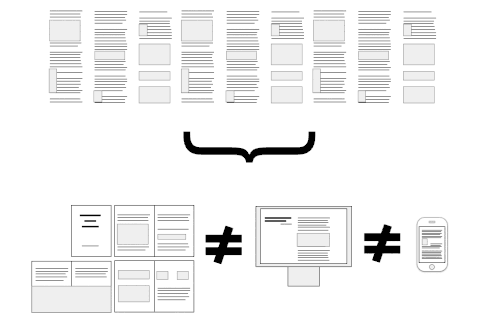
Content with form can change meaning when reformatted.

Content with form—Definite Content—is almost totally the opposite of Formless Content. Most texts composed with images, charts, graphs or poetry fall under this umbrella. It may be reflowable, but depending on how it’s reflowed, inherent meaning and quality of the text may shift.”

—Craigmod, Books in the Age of the iPad


  • Facebook
  • Google Bookmarks
  • Posterous
  • Tumblr
  • Twitter
  • RSS
  • LinkedIn

Filed under: books, content, Design, E-Books, Formats, ipad, Publications, Publishing, Standards, State of the Web, User Experience

6 Responses to “Digital books: the medium changes the message”

  1. Phoneman said on

    Loving this article. Wondering how far we can take this in say about 5 years.

  2. kevin smith said on

    After following the above link and reading the articles..
    Maybe we should burn all our books (including yours), buy a f-ning ipad and start tweeting useless shit.

    It is funny about 11 years ago I saw Jello Biafra speak (doing his spoken word gig). He was talking about the internet and the content that was on it. He also talked about how he did not (at the time) even use the internet because of the lack of quality and truthful information.
    At the end of his talk he said “do not believe everything you read on the INTERNET…”
    Now are you and people like you retweeting this spew trying to change the the way we think?
    Should we all go out and buy an ipad, iphone, ipod and a mac because you believe it is better?
    I watched Steve Jobs keynote on the Ipad. Apple is number 1 in mobile sales..
    Yeah right..

    Hopefully you get your discount on the ipad for being a fanboy.

    Sucks when not everyone is kissing your ass and telling you how great you are.

  3. Jeffrey Zeldman said on

    Hey, Kevin! Why so tense?

  4. HelveticaNeutral55 said on

    Don’t you mean dense?

  5. Bernard Yu said on

    I love the sentiment in Craig Mod’s article, it succinctly defines two types of content that I can’t help but think he’s very close to the truth of how we read and consume content. However, as a lifelong consumer of formless content and only relatively recently a (sporadic) producer of formed content, I can’t help but think that analog formless content in books have more form than he suggests and digital publications still have a long way to catch up (though, I see it having a beautiful future).

    Throughout college, but especially in the last years of college, I was a prodigious note taker, not just in binders and notebooks but in books. I devised elaborate notations to highlight passages, cross referenced to other parts of a work and even revisions to notes as well as showing which pass through a text the note was made (I went through several books multiple times). While some books were formed in a way to allow easier note taking than others, taking notes was actually quite easy: as long as I had space in the margins, I could write a note, draw a diagram, or even a mind map. I could interact with the words and phrases easily and get my ideas down.

    In digital forms, I can’t. At the moment, it would be pretty hard, if not impossible, for me to draw a diagram next to the fifth paragraph of Kant’s First Critique, or make a note about @font-face on page 329 of designing with web standards. (Sorry, 2nd edition. I haven’t had a chance to pick up the 3rd yet!) Yes, some e-readers let you add notes to parts of text, and yes pdfs allow notes, but nothing would let me draw free form notes like these. Yes, you can bullet point lists of ideas, but life is far too complex for bullet points.
    I know I am talking about edge cases, likelihood is that only an eclectic scholar is going to write in the margins of Danielle Steele’s latest novel, but it isn’t uncommon for students to write in their textbooks, it’s certainly the norm for professors and teachers. This is the power of the printed page, our interaction with it is completely unscripted and free form, not formless. Interactions with digital content has to be scripted, programmed, every interaction has to be designed, or else it is impossible.

    However, I think that there is also power and beauty of being able to move formless AND formed content into a digital realm. How beautiful could Edward Tufte’s books if we could interact with the diagrams like Hans Rosling in one of his TED talks? How amazing would it be to have an endless canvas to write and draw notes next to the First Amendment, and not just having a few square inches to summarize all your thoughts? That is the power of the iPad and all the devices to come after. We won’t just be making formless content cheaper and more environmentally friendly, We have a chance to make them formful and allow people to interact with all content in new, deeply meaningful ways.

  6. Chad Engle said on

    Thanks for pointing me back to that article Zeldman, I lost it and didn’t bookmark when I found it. Its a pretty good article.

    Kevin is pretty tense…

Comments off.